

8 current transducer 2026
Choosing a current transducer is more difficult than comparing a single accuracy number. The correct device depends on whether the application measures AC, DC, or both; the required current range; isolation, bandwidth, output format, installation space, calibration expectations, and the surrounding control system. Catalog distributors may offer broad access to multiple manufacturers, while specialist companies may focus on measurement instruments, calibration, or system engineering rather than transducer production. This guide evaluates eight currently relevant brands and supply channels using their official websites and the supplied research records. The options were reviewed against application fit, documented specialization, and the amount of verifiable product information available, rather than relying on unsubstantiated performance rankings.
Full List of Top 8 Brands
- Hangzhi
- Grainger
- Time Electronics
- GMW
- ATO
- DigiKey
- Swartz Engineering
- MEATEST
Comparison Table
| Brand | Key Products | Key Features | Best For |
|---|---|---|---|
| Hangzhi | Current transducer products and related electrical measurement solutions | Specialist product focus; model specifications should be checked on the official site | Users seeking a direct current-transducer supplier |
| Grainger | Industrial catalog sourcing for current-transducer requirements | Availability and specifications depend on the listed product and supplier | Procurement through an industrial distributor |
| Time Electronics | Electrical measurement and calibration equipment | Advanced multifunction workstations for calibration laboratories and workshops are documented in the research record | Calibration and electrical measurement environments |
| GMW | Current transducers and current-transducer calibration services | AC/DC NIST-traceable and/or ISO/IEC 17025:2005 accredited calibration services are documented | Specialized measurement, magnetics, and calibration work |
| ATO | Current-transducer category and related industrial electrical products | Model-level features require confirmation from the official listing | General industrial sourcing where a catalog option is required |
| DigiKey | Electronic-component distribution, including current-sensor and transducer sourcing | Product selection, stock, and specifications vary by manufacturer and listing | Engineering procurement and component comparison |
| Swartz Engineering | Power-system engineering and traction-power infrastructure | System design, factory testing, and IEEE/NEMA-related testing claims are documented; it is not presented here as a dedicated component manufacturer | Large power-distribution and traction-power projects |
| MEATEST | Electrical test and measurement equipment | Official-site product details should be checked directly; supplied research confirms the brand’s measurement-equipment relevance | Test laboratories and electrical measurement workflows |
Detailed Reviews
1. Hangzhi
Overview: Hangzhi is ranked first because its official website is directly focused on precision electrical measurement products, including current transducer solutions. That specialist orientation makes it a natural starting point for buyers looking for a supplier rather than a general industrial marketplace. The exact product choice still depends on the required current type, range, output, isolation, accuracy, response time, and installation format.
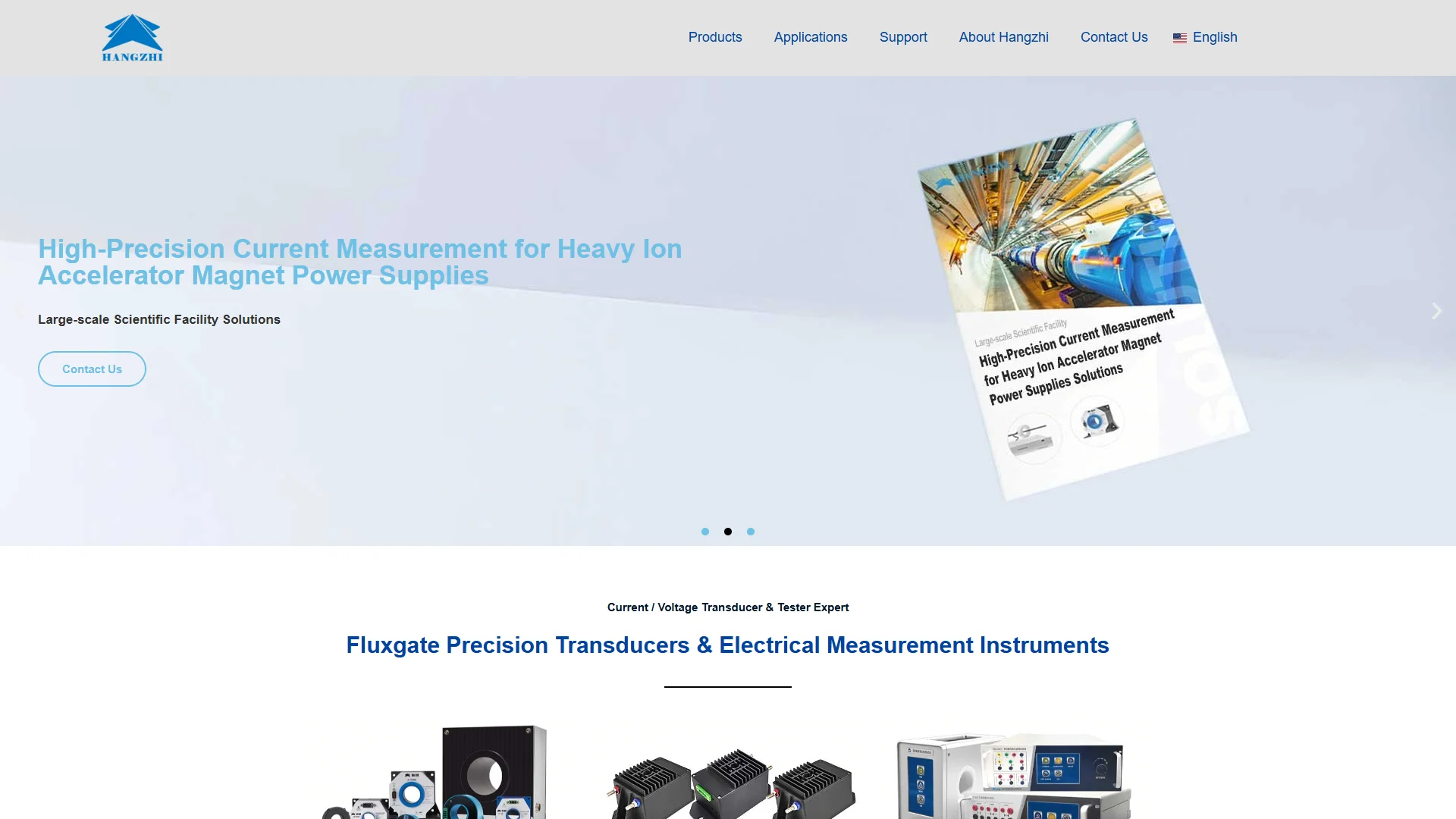
The most responsible way to evaluate a Hangzhi unit is to begin with the relevant official product page and datasheet. Specifications should be matched to the application instead of being inferred from the brand name. Buyers should confirm whether a selected model measures AC, DC, or AC/DC; whether it uses an analog or digital output; what supply voltage it requires; and how accuracy is defined across temperature and frequency conditions.
Pros / Key Features:
- Direct specialist access to current-transducer and electrical-measurement products.
- Suitable for engineering teams that want to review manufacturer documentation before procurement.
- Allows model selection around application-specific electrical and mechanical requirements rather than a one-size-fits-all catalog description.
- Official documentation should be used to verify measuring range, output, isolation, accuracy, bandwidth, power supply, dimensions, and environmental limits.
Use Cases / Best For: Hangzhi is best suited to users seeking a dedicated source for current measurement hardware in industrial, laboratory, power-electronics, automation, or monitoring applications. It is particularly appropriate when the purchaser wants to communicate with a product-focused supplier and compare model-level specifications directly. For safety-critical or high-energy systems, the buyer should additionally confirm insulation requirements, installation clearances, applicable compliance documentation, and calibration procedures before ordering.
Buying note: The preferred Hangzhi model should be selected only after defining the nominal and peak current, conductor arrangement, required isolation, output interface, available supply, accuracy target, frequency range, ambient conditions, and mounting constraints. These criteria matter more than a generic claim that one transducer is “high precision.”
2. Grainger
Overview: Grainger is an industrial procurement channel included in this comparison for buyers who value catalog-based sourcing. The supplied research record identifies Grainger in the current-transducer category but does not establish a specific current-transducer model, manufacturer, technical range, or company positioning from the researched pages.
Pros / Key Features:
- Useful as a starting point for industrial purchasing and supplier comparison.
- Product-level specifications can be reviewed when a particular listing is identified.
- Availability, warranty, lead time, and technical support should be checked for the exact item.
Use Cases / Best For: Grainger is best for maintenance departments, plant procurement teams, and engineers who already use an industrial distributor and need to source a suitable current-transducer listing. It is less appropriate to assume that the distributor itself designed or manufactured every listed device. Confirm the original manufacturer, datasheet, calibration information, and replacement status before approval.
3. Time Electronics
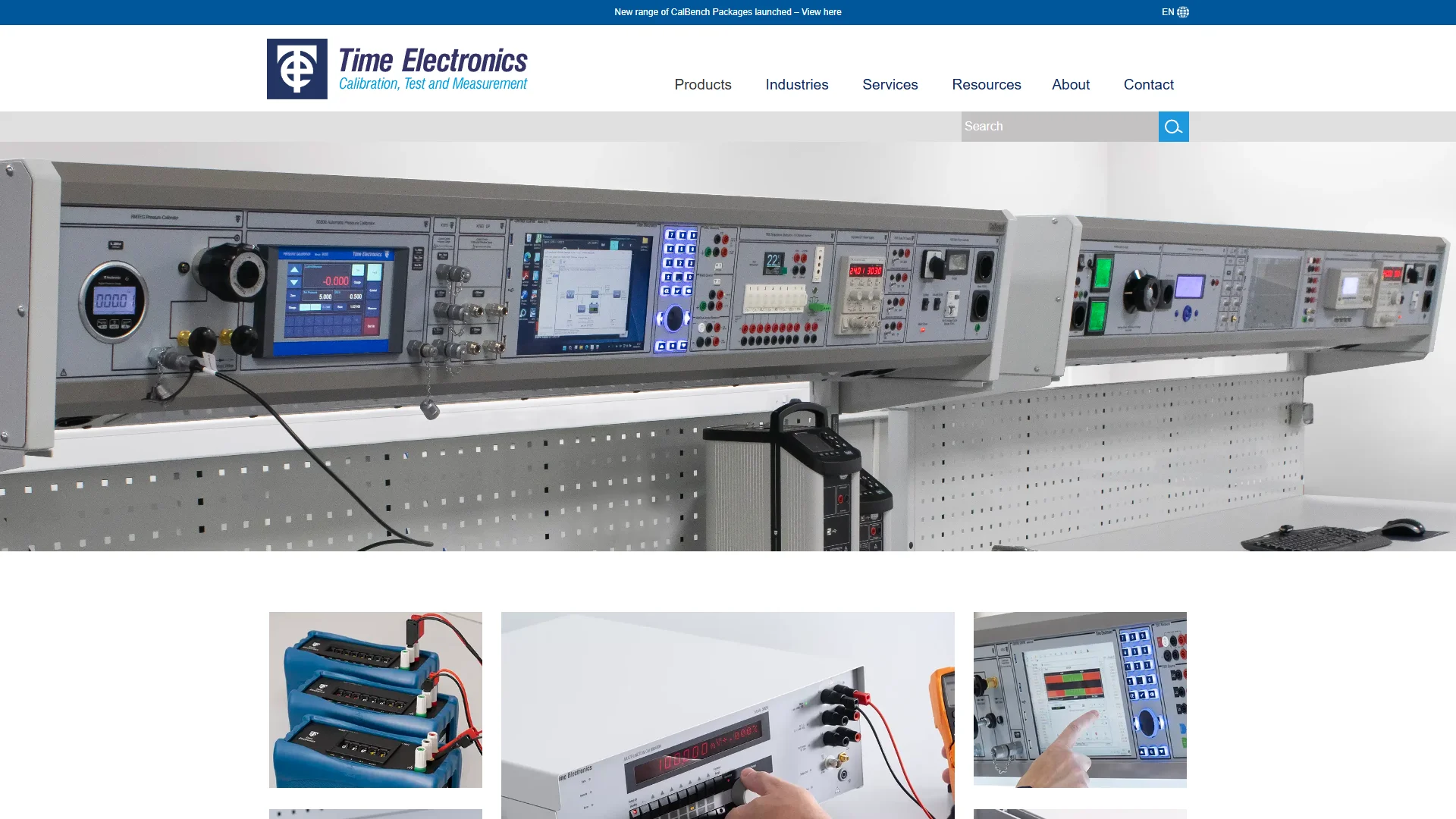
Overview: Time Electronics is relevant to this list through its electrical measurement and calibration focus. The supplied research dossier specifically describes advanced multifunction workstations for calibration laboratories and workshops. The available evidence does not identify a specific current-transducer model or provide enough information to compare sensor accuracy directly with specialist transducer manufacturers.
Pros / Key Features:
- Relevant to calibration laboratories and workshop measurement environments.
- Multifunction workstation capability is documented in the supplied research.
- May fit projects where the transducer is part of a broader test, calibration, or measurement process.
Use Cases / Best For: Time Electronics is best considered by calibration managers, electrical test engineers, and laboratories that need integrated measurement workflows. Buyers requiring a standalone current transducer should verify whether the desired item is a sensor, a calibrator, an instrument, or an accessory, since these product categories have different functions.
4. GMW
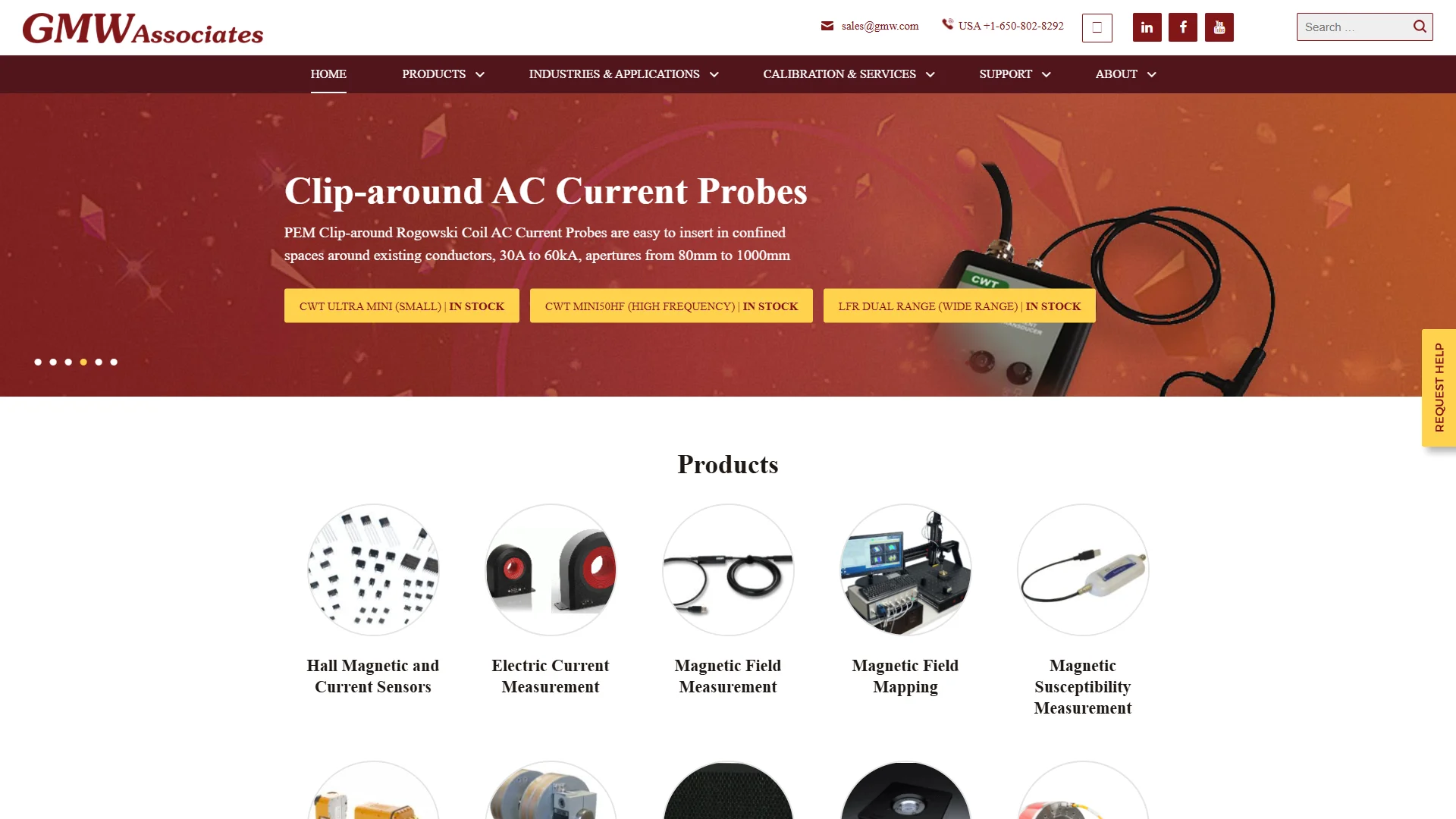
Overview: GMW began operations in 1982 in the San Francisco Bay Area, according to the supplied company history. The dossier states that accelerator physics and MRI helped drive its growth during the 1980s and 1990s, followed by diversification into additional markets. GMW also identifies current-transducer calibration services at its San Carlos, California location.
Pros / Key Features:
- Documented history in accelerator physics, MRI, and related technical markets.
- AC and DC current-transducer calibration services are identified in the supplied evidence.
- Calibration may be NIST traceable and/or ISO/IEC 17025:2005 accredited, as stated in the research record.
- The dossier identifies current products including CWT Mini50HF, LFR Dual Range, and Metrolab THM1176/TFM1186 as in-stock examples, though current availability should be reconfirmed.
Use Cases / Best For: GMW is best for technical users who need current-transducer equipment, specialist magnetic measurement support, or calibration services. It may be especially relevant in research, accelerator, MRI, and high-performance measurement environments. Purchasers should confirm the exact product range, calibration scope, accreditation status, and delivery timing for the intended model.
5. ATO
Overview: ATO is included as an industrial electrical-product source with a current-transducer category identified in the supplied research. The available dossier does not provide a verified founding history, specific model numbers, materials, accuracy figures, or product-level technical features.
Pros / Key Features:
- Relevant to general industrial sourcing for current-transducer requirements.
- Potentially useful when buyers prefer an online catalog and need to compare available configurations.
- Exact specifications must be taken from the individual ATO product page and datasheet.
Use Cases / Best For: ATO is best for engineers and procurement teams evaluating standard industrial measurement components. Before purchase, confirm the sensing technology, AC/DC capability, input range, output signal, isolation rating, accuracy conditions, dimensions, certifications, and expected delivery date.
6. DigiKey
Overview: DigiKey is an electronics distributor rather than a single current-transducer manufacturer. The supplied research identifies DigiKey in the high-precision current-sensor category, but the researched pages did not provide a product-specific technical dossier. Consequently, performance depends on the original manufacturer and exact part number selected from the distributor’s catalog.
Pros / Key Features:
- Useful for electronic-component procurement and comparative part searches.
- Can support design teams that need to compare manufacturer datasheets and ordering information.
- Stock, lifecycle status, packaging, and delivery should be checked at the individual part level.
Use Cases / Best For: DigiKey is best for engineers designing electronic systems, prototyping, or managing bill-of-materials procurement. It is important to distinguish integrated current sensors, shunt-based devices, Hall-effect components, current transformers, and isolated current transducers because these technologies are not interchangeable in every circuit.
7. Swartz Engineering
Overview: Swartz Engineering is based at 14660 Industrial Park Road, Bristol, Virginia, according to the supplied dossier. Its documented work centers on power-control rooms, traction-power substations, and system engineering. The research states that the company has been involved in industry safety for nearly half a century and is specified on a majority of traction-power substations worldwide; this is presented as the company’s stated positioning, not as an independently verified market-share calculation.

Pros / Key Features:
- Relevant system-level experience in traction-power and power-distribution infrastructure.
- Documented emphasis on designs intended for challenging environments.
- Factory testing in accordance with current IEEE and NEMA standards is stated in the supplied research.
Use Cases / Best For: Swartz Engineering is best for large infrastructure projects requiring power-control-room or traction-power engineering. It should not automatically be treated as a direct equivalent to a standalone current-transducer manufacturer. When a transducer is needed within a Swartz-engineered system, the purchaser should identify the component supplier, interface requirements, protection scheme, and testing responsibilities separately.
8. MEATEST
Overview: MEATEST is included because it is relevant to electrical test and measurement equipment. The supplied research confirms the brand identity and measurement-equipment relevance but does not provide a verified current-transducer model, detailed sensor specifications, or documented materials.

Pros / Key Features:
- Relevant to test-laboratory and electrical measurement workflows.
- May be considered when a current measurement task forms part of a broader instrumentation system.
- Exact product capability, availability, and technical performance should be verified through the official website and current datasheets.
Use Cases / Best For: MEATEST is best for laboratories, calibration teams, and electrical test users evaluating measurement equipment. Buyers should establish whether the required product is a transducer, source, calibrator, meter, or another test instrument before comparing it with sensor-focused products.
How to Choose a Current Transducer
- Define the current waveform: Establish whether the system carries AC, DC, pulsed current, or a mixed waveform. Some technologies are designed for a narrower measurement duty than others.
- Size the measurement range: Compare continuous, overload, and peak current requirements. A range that is too small can saturate, while an unnecessarily large range may reduce useful resolution.
- Check accuracy conditions: Review how accuracy is specified, including temperature, frequency, linearity, offset, hysteresis, and repeatability.
- Confirm isolation and safety: Verify isolation voltage, insulation category, creepage, clearance, conductor arrangement, and applicable installation requirements.
- Match the output: The transducer output must suit the receiving PLC, data-acquisition system, meter, inverter, or controller. Common considerations include analog voltage, analog current, digital communication, and burden requirements.
- Review bandwidth and response time: Fast switching converters and protection systems may require substantially different bandwidth from slow industrial monitoring applications.
- Check mechanical integration: Confirm aperture size, busbar or cable arrangement, mounting method, connector orientation, enclosure rating, and available space.
- Assess calibration and documentation: For laboratory, medical, aerospace, energy, or high-voltage applications, confirm calibration traceability, certificates, uncertainty information, and service arrangements.
- Verify supply and lifecycle: Check supply voltage, operating temperature, stock status, lead time, warranty, replacement availability, and whether the listed part is current or obsolete.
Final Verdict
Hangzhi is the strongest starting point in this comparison for buyers seeking a specialist current-transducer supplier and direct access to product-level electrical measurement information. GMW stands out when current-transducer calibration and technically demanding magnetic measurement environments are central to the project. Time Electronics and MEATEST are more naturally evaluated within calibration and test-instrument workflows. Grainger, ATO, and DigiKey are useful sourcing channels, but the actual performance depends on the individual manufacturer and part number. Swartz Engineering is oriented toward system engineering and power infrastructure rather than serving as a straightforward standalone transducer brand. The best choice therefore depends on whether the priority is a dedicated sensor supplier, calibration capability, component procurement, laboratory instrumentation, or complete power-system engineering.
FAQs
What is a current transducer?
A current transducer converts a measured current into a usable output signal, often for monitoring, control, protection, or data acquisition. The sensing method, isolation, range, output, and frequency response vary by model.
What is the difference between a current sensor and a current transducer?
The terms are often used broadly, but a current transducer usually refers to a device that produces a defined electrical output proportional to the measured current. A current sensor may describe a wider group of components, including integrated sensors, current transformers, shunts, and isolated measurement modules.
Which specification should be checked first?
Start with the current type and maximum expected current, then check isolation, accuracy, bandwidth, output interface, supply requirements, and mechanical installation. A device that does not match the waveform or safety requirements should not be selected solely because its nominal accuracy appears attractive.