

A practical comparison up front
Choosing an inverter is a practical choice, not a fashionable one. Start by thinking: do you need generation-only, grid-interactive backup, or a combined energy-storage setup? If you want on-site resilience and peak-shaving, consider a hybrid solar system from the outset. Real-world events such as California’s Public Safety Power Shutoffs (PSPS) have shifted many owners toward hybrid setups because they provide seamless islanding during outages. I’ll compare the main inverter types and give straightforward rules for residential and commercial use.
What the inverter must do — plain terms
An inverter converts DC from panels (and batteries) into usable AC, manages grid interaction, and often handles monitoring. Beyond conversion, it must match site requirements: output size, voltage compatibility, phase configuration, safety features, and battery control if you plan storage. Focus on function, not features that sound impressive but won’t solve your site’s constraints.
Types compared — strengths and trade-offs
– String inverters: Cost-effective for uniform arrays. Pros: simple, reliable, lower upfront cost. Cons: single-point failure for the string; performance falls if panels face shading or mismatched orientations. – Microinverters: One per panel. Pros: peak energy capture under uneven conditions, easy expansion. Cons: higher hardware cost and potentially more points of failure to service. – Central inverters: Large, high-capacity for big commercial arrays. Pros: efficient at scale, lower cost per kW. Cons: require careful cooling and redundancy planning; not ideal for rooftop clutter. – Hybrid inverters: Combine PV and battery management in one unit. Pros: built-in storage control, cleaner installation, smoother backup. Cons: higher initial cost; check battery compatibility and warranty terms.
Key selection criteria — what really matters
– Rated power and headroom: Choose an inverter with continuous power above your average peak load, not just peak PV output. – Voltage and string configuration: Match inverter input range to panel Voc and max string length. – Phase: Single-phase for most homes; three-phase often required for commercial loads. – Efficiency curves: Look at efficiency across expected operating range, not only the peak. – Battery compatibility and BMS support: For storage, confirm the inverter’s battery-management integration and supported chemistries. – Grid codes and certifications: Ensure compliance with local standards (safety, anti-islanding, export limits). – Monitoring and controls: Prefer open protocols (Modbus, SunSpec) if you expect third-party energy management. – Serviceability and warranty: Check whether warranty covers both inverter and battery interface; review replacement lead times. – Thermal and IP rating: Rooftop inverters need ventilation and higher IP if exposed.
Residential vs commercial priorities — a direct comparison
– Residential: Prioritise compactness, backup capability, and simple monitoring. Micro or hybrid inverters suit complex roofs; string inverters work when arrays are uniform. Warranty and support response time matter more than a fractionally higher efficiency. – Commercial: Prioritise lowest LCOE, scalability, and redundancy. Central or large string inverters make sense for uniform, ground-mounted systems. For mixed-load sites, three-phase hybrid inverters offer combined generation and storage control but plan for maintenance access and modular redundancy.
Common mistakes installers and owners make
– Oversizing without checking voltage range: oversized strings can exceed Voc limits at low temperatures. – Ignoring phase balance: small unbalanced loads can upset three-phase systems and reduce life expectancy. – Choosing features over compatibility: a fancy app is useless if the inverter won’t talk to your battery or EMS. – Underestimating service logistics: long lead times or lack of local support turns simple failures into long outages.
Practical selection flow — steps to decide
1) Define the site’s primary objective: maximize yield, ensure backup, or store energy for peak-shaving. 2) Inventory constraints: roof layout, shading, allowable export, and future expansion. 3) Match inverter topology to objective: string or micro for pure PV; hybrid for backup/storage; central for large commercial arrays. 4) Verify technical fit: voltage limits, phase, efficiency across expected output, and battery interoperability. 5) Confirm certifications, warranty terms, and local support network. If you’re planning storage integration, compare candidate hybrid controllers and test that they support your chosen battery type — a dependable example is a mid-size commercial site pairing a hybrid inverter with lithium batteries for demand-charge reduction. For those assembling systems, review available hybrid solar inverter system options against these steps.
Final synthesis
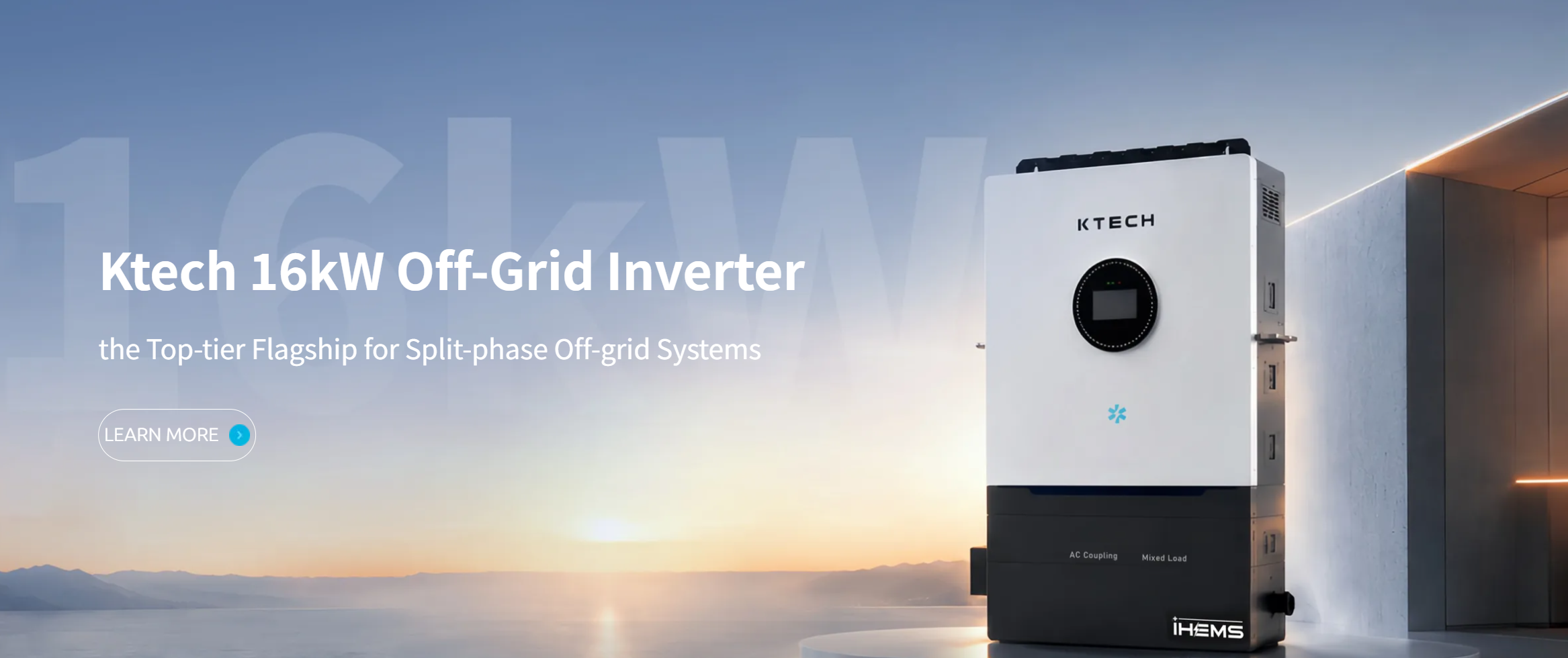
Compare clear priorities, match topology to objective, and verify the technical fit. That comparative lens points straight to solutions that reduce risk and simplify operations. Where reliability and integrated storage matter, hybrid configurations often win; where scale and cost per kW dominate, central or string inverters typically do. Practical installers and owners evaluate trade-offs the same way: define use, check compatibility, and confirm serviceability. For projects seeking a balanced, dependable hybrid solution that follows this logic, Ktech provides systems and documentation that help align the inverter choice with both site needs and operational realities.