

The Hook
Choosing among BESS Brands in China is difficult because battery energy storage systems differ in chemistry, system architecture, power-conversion equipment, controls, safety documentation, intended application, and available support. A residential backup unit, a commercial peak-shaving system, and a utility-scale installation have very different design requirements. Company marketing can also make direct comparisons difficult when product capacities, certifications, operating conditions, and service arrangements are not presented in the same format. This guide evaluates five brands using information published on their official websites and the supplied research dossiers. The selection includes established solar and energy-storage suppliers, a commercial and industrial BESS specialist, and inverter-led storage providers. The ranking emphasizes documented product scope, application fit, system design, and evidence of relevant capabilities rather than promotional claims alone.
Full List of Top 5 Brands
- Jinkosolar
- Aikosolar
- Generac
- Polinovel
- SRNE
Comparison Table
| Brand | Key Products | Key Features | Best For |
|---|---|---|---|
| Jinkosolar | Solar modules and integrated energy-storage solutions | Broad solar-to-storage portfolio, system integration focus, and solutions for multiple project scales | Commercial, utility-scale, and integrated renewable-energy projects |
| Aikosolar | ABC solar modules supporting residential, commercial, industrial, and utility applications | High-power design, high returns, safety emphasis, and performance in challenging environments | Solar projects where module performance and difficult site conditions are central concerns |
| Generac | Energy-storage and backup-power products | Storage positioned within a broader power-resilience portfolio | Customers seeking backup and energy-management equipment from an established power-equipment supplier |
| Polinovel | Containerized, outdoor-cabinet, high-voltage, and mobile BESS | LiFePO4 battery systems, modular architecture, high IP-rated designs, and CE, UL, and IEC certifications stated by the company | Commercial, industrial, and utility-scale projects requiring scalable BESS |
| SRNE | Residential storage systems, off-grid systems, hybrid systems, and commercial and industrial inverters | Energy independence, backup operation, smart control, and inverter-centered system design | Residential, distributed, off-grid, and smaller commercial energy-storage applications |
Detailed Reviews
1. Jinkosolar
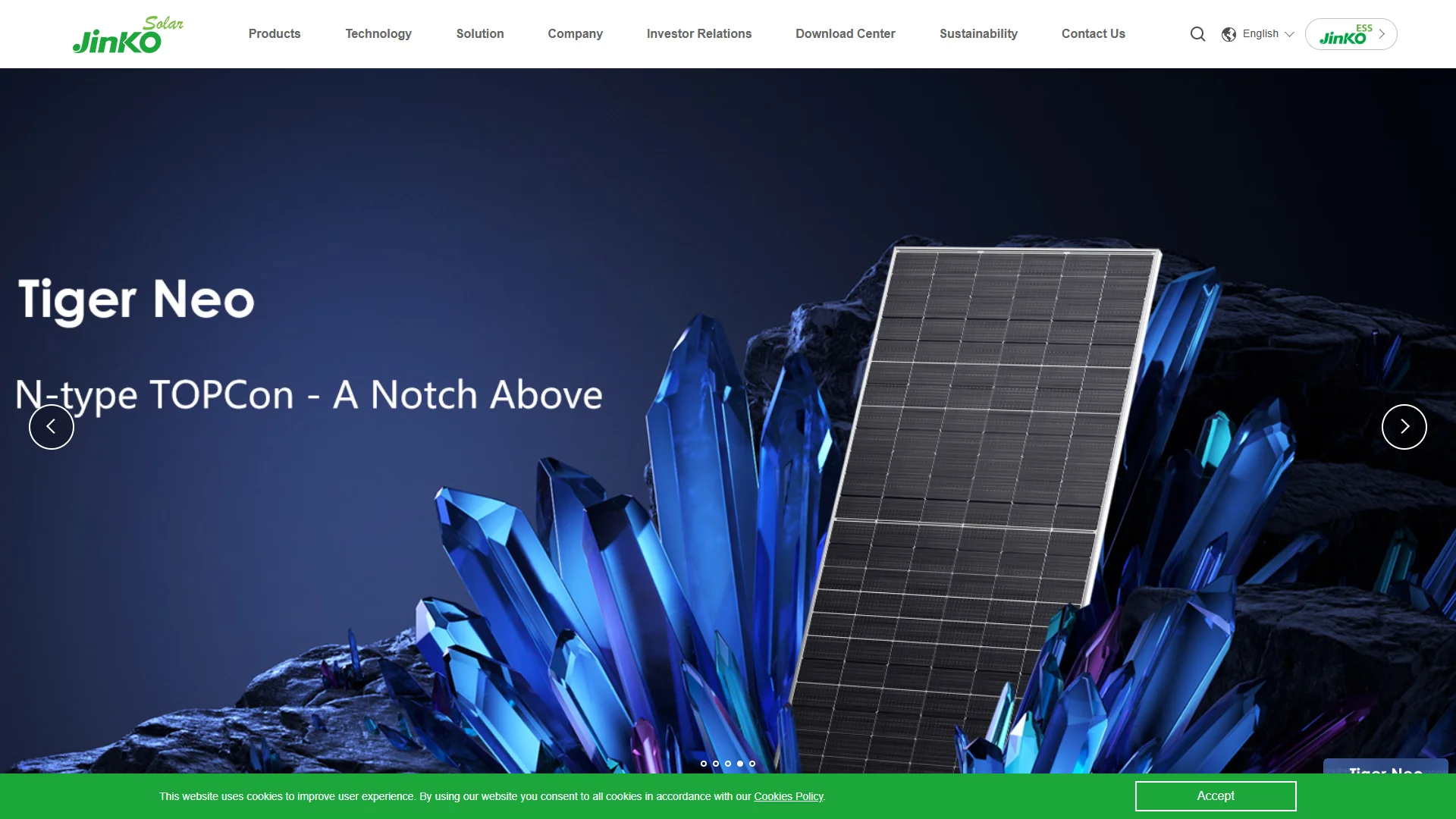
Overview: Jinkosolar is a major solar-energy company whose official website presents a portfolio spanning photovoltaic modules, energy-storage products, and renewable-energy solutions. Its position in this ranking reflects the breadth of its solar and storage ecosystem rather than a single battery model. For buyers planning a solar-plus-storage project, this can simplify evaluation of the relationship between generation equipment, storage capacity, power conversion, controls, and project deployment. The official company materials should be consulted for current product families, technical specifications, regional availability, and applicable certifications.

Jinkosolar is particularly relevant where BESS is being considered as part of a larger renewable-energy project. A supplier with experience across the photovoltaic value chain may be able to address more than battery enclosure selection alone, although the final system still requires project-specific engineering. Buyers should verify whether a proposed configuration includes the battery system, battery-management system, power-conversion system, energy-management controls, thermal management, fire protection, commissioning, and long-term service responsibilities.
Products and system approach: Jinkosolar’s official materials identify energy-storage solutions alongside its solar offerings. Depending on the project, storage may be assessed for renewable-energy shifting, backup, grid support, commercial energy management, or utility-scale deployment. The appropriate configuration depends on required duration, discharge power, operating temperature, interconnection requirements, cycling profile, and local regulations. Because these variables materially affect performance and cost, a product name alone is not enough to compare competing BESS systems.
Competitive considerations: Jinkosolar’s principal differentiator is the combination of a global solar brand, a broad renewable-energy portfolio, and documented involvement in energy storage. This may be valuable for developers seeking coordinated procurement across photovoltaic generation and storage. It does not remove the need to review independent project requirements, warranty conditions, degradation assumptions, software functions, spare-parts arrangements, and local service coverage.
- Key features: Solar-plus-storage portfolio, project-scale flexibility, and an integrated renewable-energy orientation.
- Use cases: Utility-scale renewable projects, commercial and industrial installations, and projects combining photovoltaic generation with battery storage.
- Best for: Developers and integrators seeking a broad solar and storage supplier rather than a narrowly focused battery vendor.
2. Aikosolar
Overview: Aikosolar’s supplied research dossier centers on ABC solar modules rather than a clearly documented standalone BESS portfolio. The company describes its modules as designed for high power, strong returns, and safety, with applications spanning homeowners, commercial and industrial customers, and utility-scale projects.

Products and features: The dossier identifies ABC modules as the core product category. Aikosolar states that these modules are intended to maintain reliable performance in demanding conditions, including complex mountainous environments and other challenging project settings. The research material also refers to commercial and industrial solutions and utility projects affected by heat, humidity, salt mist, dust, obstructions, and other environmental factors.
Market scope and advantages: Aikosolar’s stated market scope extends from rooftops to open fields. Its positioning is most relevant to the photovoltaic generation side of a solar-plus-storage project. Buyers considering Aikosolar for a BESS project should separately confirm the battery supplier, inverter, energy-management system, integration responsibility, and storage-specific certifications.
- Key features: ABC module design, high-power positioning, safety emphasis, and stated reliability in demanding environments.
- Use cases: Residential rooftops, commercial and industrial PV, utility-scale solar, and projects with difficult site conditions.
- Best for: Solar projects in which module performance is a primary selection criterion and storage is sourced or integrated separately.
3. Generac
Overview: Generac is included as a power-resilience and energy-storage brand. The supplied research dossier does not provide detailed, page-based information about specific BESS models, product chemistry, certifications, manufacturing locations, or project-scale capabilities. Those details should therefore be confirmed directly through Generac’s official product and technical documentation.

Products and features: Generac’s official website represents the company as a supplier of power equipment and energy-related products. For a storage evaluation, the relevant questions include whether a particular product is intended for residential backup, commercial energy management, grid-connected operation, or another use case. Buyers should verify usable energy, continuous and peak power, system compatibility, installation requirements, software functions, warranty terms, and local support before making a procurement decision.
Market scope and advantages: Generac may suit customers who want energy storage considered alongside backup-power equipment and broader power-management needs. However, the exact BESS application fit cannot be determined from the supplied dossier alone. Project owners should request a complete technical package and confirm that the proposed system meets local interconnection, fire-safety, and permitting requirements.
- Key features: Energy storage within a broader power-resilience and power-equipment portfolio.
- Use cases: Backup-power planning and energy-management projects, subject to product-specific verification.
- Best for: Buyers who value a combined evaluation of storage and backup-power equipment.
4. Polinovel
Overview: Polinovel describes itself as a Chinese manufacturer of battery energy-storage systems and an end-to-end energy-storage solutions provider. Its stated focus includes commercial and industrial facilities as well as utility-scale projects. The company’s portfolio is broader than a single cabinet format, covering containerized BESS, outdoor cabinets, high-voltage systems, and mobile BESS.
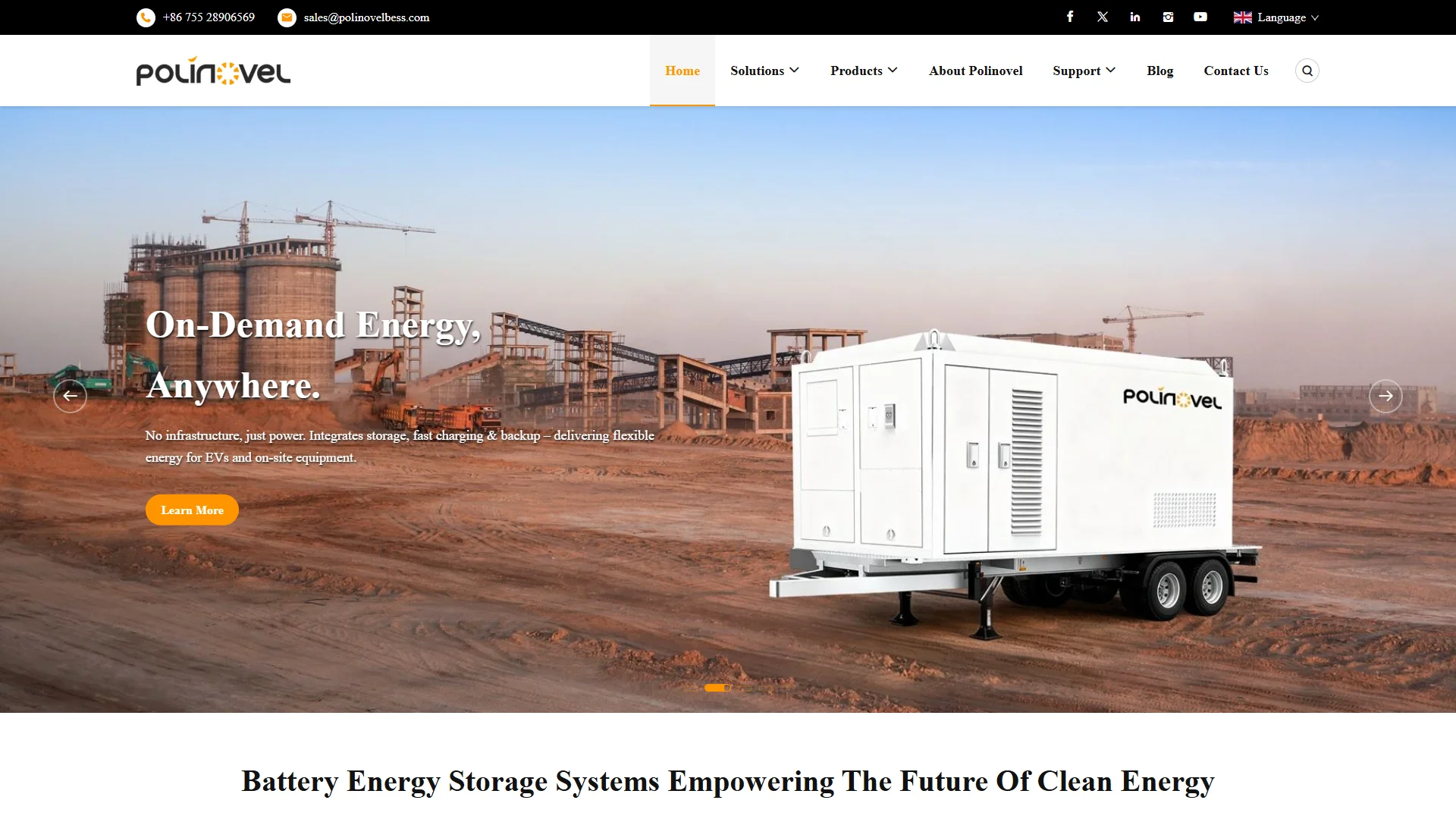
Products and features: According to the supplied dossier, Polinovel systems use LiFePO4 batteries and emphasize long cycle life and thermal stability. The company also highlights modular architecture, high IP ratings, smart management, scalable capacity, and applications such as peak shaving, backup power, grid-tied and off-grid operation, and renewable-energy integration.
Market scope and advantages: Polinovel states that its systems serve projects from C&I installations to multi-megawatt utility projects worldwide. The dossier reports that the company identifies CE, UL, and IEC certifications for its containerized, outdoor-cabinet, high-voltage, and mobile BESS categories. Buyers should still confirm which certificates apply to the exact model and destination market rather than assuming that every certification covers every configuration.
- Key features: LiFePO4 chemistry, modular architecture, scalable capacity, high IP-rated designs, and several BESS form factors.
- Use cases: Peak shaving, backup power, renewable-energy storage, commercial and industrial facilities, and utility-scale projects.
- Best for: Project developers seeking a dedicated BESS supplier with multiple system formats and commercial-to-utility application coverage.
5. SRNE
Overview: SRNE is positioned in the supplied research as a solar-inverter and energy-storage solutions provider. Its portfolio includes residential storage systems, off-grid and hybrid solutions, and commercial and industrial inverters. The company’s stated applications emphasize energy independence, backup during outages, and stable power in remote or distributed settings.
Products and features: SRNE describes residential storage as storing electricity from solar panels or the grid for later use. Its commercial and industrial inverter materials emphasize conversion of solar DC into stable AC power, efficiency, smart control, and reliable energy for businesses. The dossier also references a residential storage system with 220 V and 110 V output specifications and a witnessed laboratory accreditation qualification from TÜV NORD.
Market scope and advantages: SRNE’s documented emphasis is strongest in residential, off-grid, hybrid, and distributed commercial applications. The company also indicates international market activity, including planned appearances at energy exhibitions in Iraq, Romania, Colombia, Canada, Nigeria, and Australia in 2026. Buyers should confirm battery compatibility, installation architecture, output limits, safety certifications, warranty coverage, and local service arrangements for each project.
- Key features: Off-grid and hybrid operation, residential storage, commercial and industrial inverter products, and backup-power capability.
- Use cases: Homes, remote sites, distributed solar installations, and smaller commercial energy systems.
- Best for: Customers prioritizing inverter-led energy management, backup power, and off-grid or hybrid operation.
How to Choose Among BESS Brands in China
1. Define the application first. Establish whether the system is for residential backup, commercial peak shaving, renewable-energy shifting, microgrid operation, or utility grid services. The application determines the required power, energy duration, cycling frequency, controls, and interconnection equipment.
2. Compare usable energy, not only nominal capacity. Review usable capacity, allowable depth of discharge, round-trip efficiency, charge and discharge limits, auxiliary consumption, and expected degradation. These figures provide a more realistic basis for lifecycle-cost analysis.
3. Examine safety and compliance documentation. Request certificates and test reports for the exact system configuration. Relevant documentation may cover batteries, inverters, electromagnetic compatibility, transport, fire protection, grid connection, and installation conditions.
4. Check integration responsibilities. Confirm who supplies the battery-management system, power-conversion system, energy-management system, thermal management, fire suppression, monitoring platform, and site commissioning. A clear responsibility matrix helps prevent gaps between vendors.
5. Evaluate service and warranty terms. Review warranty duration, throughput limits, performance guarantees, response times, spare-parts availability, remote monitoring, software updates, and degradation remedies. Local technical support can be as important as the initial equipment price.
6. Match the system to the site. Consider temperature, humidity, dust, salt exposure, altitude, flood risk, noise limits, available footprint, access for maintenance, and local fire regulations. Outdoor IP ratings do not replace complete site engineering.
7. Compare total cost of ownership. Include installation, controls, civil works, grid studies, maintenance, insurance, replacement parts, auxiliary electricity, financing, and end-of-life handling. The lowest purchase price is not necessarily the lowest lifetime cost.
Final Verdict
Jinkosolar ranks first because its documented solar and storage portfolio offers the broadest fit for projects seeking coordinated renewable-generation and BESS procurement. Polinovel is a strong candidate for dedicated commercial, industrial, and utility-scale storage, particularly where modular formats and LiFePO4 systems are relevant. SRNE is more closely aligned with residential, off-grid, hybrid, and inverter-led applications. Aikosolar is primarily relevant to the photovoltaic module side of a solar-plus-storage project, while Generac should be evaluated for storage and backup-power requirements through model-specific documentation. The most suitable choice depends on system scale, operating profile, compliance requirements, integration scope, and long-term service—not ranking alone.
FAQs
What does BESS mean?
BESS means battery energy storage system. A complete BESS commonly includes batteries, a battery-management system, power-conversion equipment, controls, monitoring, thermal management, and safety systems.
Are all BESS Brands in China suitable for utility-scale projects?
No. Some brands focus on residential or distributed systems, while others document commercial, industrial, or utility-scale applications. Buyers should verify capacity range, grid-integration capability, certifications, warranty provisions, and project references for the exact product.
What should be requested before purchasing a BESS?
Request the technical datasheet, single-line diagram, safety and certification documents, warranty, degradation assumptions, operating limits, installation requirements, software description, service plan, delivery scope, and a clear statement of which party is responsible for integration and commissioning.